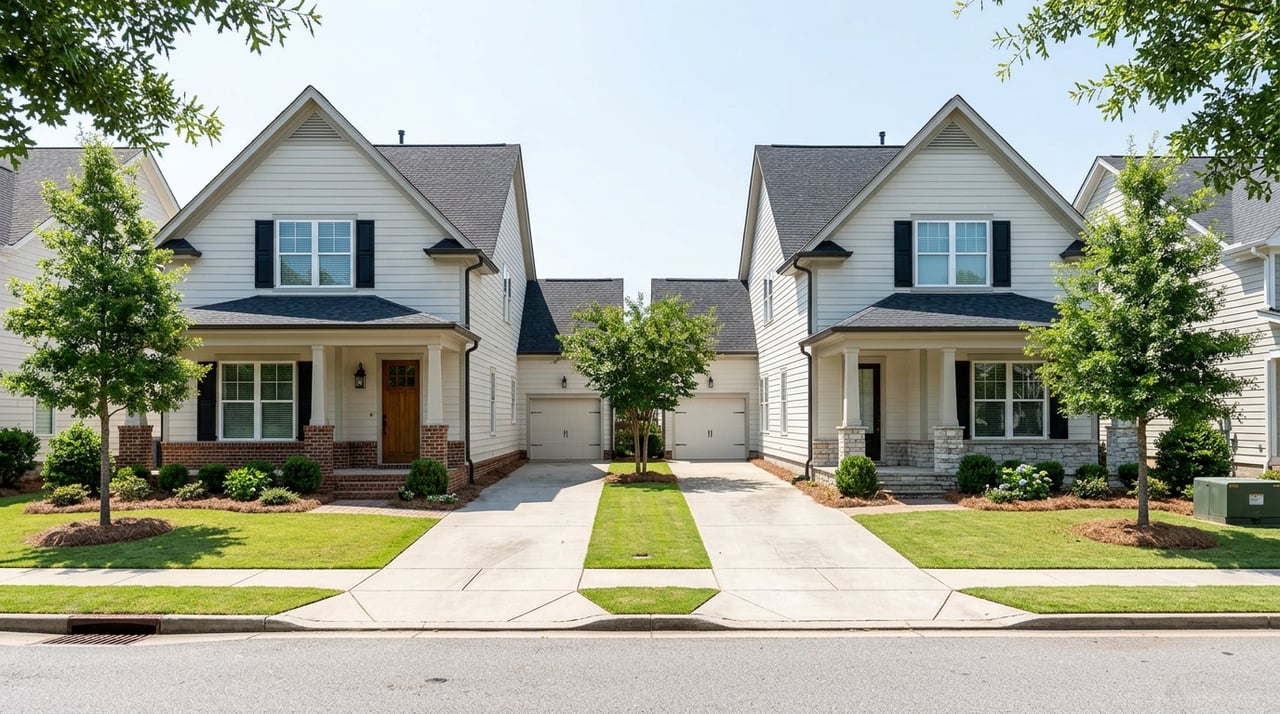
Sharpsburg Small Subdivision Land: What to Check First
July 16, 2026
July 16, 2026
If you are thinking about carving a few lots out of land near Sharpsburg, the biggest mistake is assuming a small subdivision will be simple. Around 30277, even modest projects can hinge on where the tract sits, how it is zoned, whether it has legal frontage, and if each lot can support septic or utility service. The good news is that with the right early due diligence, you can spot workable opportunities faster and avoid expensive surprises later. Let’s dive in.
Sharpsburg itself is very small, with an official population listed at 341 and an estimate of 347. Coweta County, however, continues to grow, with a 2025 population estimate of 160,240, up 9.6% since 2020. That contrast matters if you are planning a small subdivision, because demand can be broader than the town’s footprint alone.
Countywide housing data also points to a market centered on ownership. Coweta County reports a 78.4% owner-occupied housing rate, a median owner-occupied home value of $357,500, a median household income of $95,548, and 751 building permits recorded in 2025. Taken together, those figures suggest room for owner-occupied detached housing, especially where the zoning and infrastructure line up with the product you want to build.
Before you sketch lot lines, confirm whether the property is inside the Town of Sharpsburg or in unincorporated Coweta County. That single step can change your lot size, frontage, access, utility expectations, and approval path. A tract with a Sharpsburg mailing address is not automatically governed by the town.
In unincorporated Coweta, many rural tracts fall under the RC district. That district is intended for agricultural and low-density single-family residential land use, and subdivision approvals must align with the county’s Land Development Guidance System map. The county also ties development to specific single-family formats such as CSD, EL-2, EL-A, and EL-5.
Inside Sharpsburg, the zoning standards are different. The town’s district table shows R1 and R1A at 1.5 acres, and R2 at 0.75 acre, each with 80 feet of road frontage. Sharpsburg also limits its medium-density R2 district to the town’s 2005 corporate limits or to small annexed tracts of 10 acres or less intended for R2-approved uses.
In unincorporated Coweta’s RC district, by-right subdivision options differ a lot in scale. EL-2 is a 2-acre lot product, EL-5 is a 5-acre lot product, and EL-A requires a 20-acre minimum tract with an average lot size of 7.5 acres and no lot smaller than 3 acres. Those standards make rural estate-style planning more realistic than compact subdivision design on many county parcels.
Sharpsburg allows somewhat smaller lots in certain districts, but compact development still has limits. If you are looking at higher-density detached or attached homes, the town’s Planned Community Development district is the main local path for that type of product. That district allows detached, cluster, or attached homes, but it comes with a much heavier infrastructure and design burden.
For a Planned Community Development in Sharpsburg, the tract must be at least 50 acres. It must include 25% open space and have access only on collector or major streets. It also requires public water, public sewer, sidewalks, streetlights, curb and gutter, and underground utilities.
Access is one of the first issues to test, not one of the last. Coweta County generally requires each lot to front a public street. If a tract looks attractive on paper but depends on limited frontage, an old farm lane, or uncertain easement access, the concept may need to be reworked early.
The county does allow a narrow exception for some small residential layouts. One ingress, egress, and utility easement from a public street may serve no more than three lots, but the easement must be at least 30 feet wide, the drive itself must be at least 10 feet wide, and the owners must be bound by a perpetual maintenance agreement. That can be useful for a very small split, but it is not a broad substitute for proper road frontage.
Road layout matters on larger subdivisions too. If a subdivision has 50 to 249 lots and does not front a collector or higher roadway, the county requires at least two street outlets to a collector or higher road. Also, if an existing subdivision street does not meet current standards, access can be denied until that street is upgraded.
Driveway geometry can affect feasibility as well. The county notes that curb cuts are generally 30 feet for two-way entrances and 16 feet for one-way entrances unless another standard is approved. If your frontage is tight, those measurements should be reviewed before you move too far into design.
For many small subdivisions around Sharpsburg, septic feasibility is the real gatekeeper. In Coweta’s dimensional standards, a lot will not be approved for development or building unless the county has proof that the site can support a conventional on-site septic system. The county may also require a larger lot size to accommodate the septic area.
That means meeting minimum acreage on paper is not enough. The county Environmental Health office and District 4 Public Health handle septic permitting, so septic review belongs near the front of your due diligence process. Waiting until after closing can turn a promising concept into a costly problem.
Water service depends on the zoning framework and the specific project. In Coweta’s RC district, lots may use either a well or a public water system. In the county’s EL-2 estate-lot format, water may come from public water or private wells, while wastewater must be handled by individual septic systems.
Inside Sharpsburg’s Planned Community Development standards, the utility bar is much higher. Water and sewer facilities must be adequate for the project, or there must be a definite proposal to provide them. On projects where public utilities are involved, development coordination may also require plan submissions and engineering details through Coweta County Water & Sewerage Authority standards.
A tract can appear wide open from the road and still lose buildable area once the site is mapped correctly. In Coweta’s RC district, the county specifically aims to preserve primary conservation land. That includes floodplain, stream buffers, wetlands, slopes of 25% or greater, endangered species habitat, archaeological sites, cemeteries, and burial grounds.
For a small subdivision, that matters because every constrained area can reduce lot count, shift road placement, or change where septic fields can go. It can also affect whether a by-right concept remains practical. Early topographic and environmental mapping can save months of redesign.
Stormwater is another piece that should not be treated as a later permit item. Coweta says its stormwater program operates to EPA, Georgia EPD, and Metro North Georgia Water Planning District requirements, and stormwater plans must be prepared under the direct supervisory control of a registered professional engineer or a registered landscape architect. The county building department also enforces grading, zoning, and floodplain regulations.
If you are evaluating a tract around Sharpsburg, a clear order of operations can help you avoid wasted time and soft costs. The local rules point to a practical sequence that works well for small builders, landowners, and investors.
Determine whether the property is inside Sharpsburg or in unincorporated Coweta County. This affects zoning rules, lot dimensions, frontage standards, and utility expectations.
Identify the zoning district and check whether the proposed subdivision type fits the county or town framework. In unincorporated Coweta, that means reviewing the RC district rules and the Land Development Guidance System map where applicable.
Review public road frontage, shared access possibilities, driveway geometry, and whether a private access solution is actually allowed. This is often where small-subdivision concepts become either viable or unworkable.
Ask Environmental Health about conventional septic support before finalizing a lot layout. If the soil or reserve area does not work, the lot count may need to change.
Identify floodplain, streams, wetlands, steep slopes, and other protected or limiting features. These constraints can shrink usable land even when the gross acreage looks promising.
Final plats must be drawn and sealed by a professional registered land surveyor, and stormwater plans require qualified design oversight. In practical terms, that means a surveyor, civil engineer, and planner should be involved before a rezoning concept or plat submission moves too far.
Based on the local zoning structure and current county housing profile, owner-occupied detached homes appear to be the strongest fit for many small subdivision opportunities around Sharpsburg. In rural county areas, larger-lot and estate-lot formats often align more naturally with the code. More compact or attached product usually makes more sense only where the town’s planned-development framework and utility requirements can be satisfied.
That does not mean every tract should become a large-lot project. It means the land should guide the strategy. The most successful small subdivisions around 30277 usually start with realistic assumptions about frontage, septic, conservation limits, and whether the property is truly positioned for county-style estate lots or a more infrastructure-heavy town concept.
If you are considering a land purchase, evaluating acreage you already own, or planning a small subdivision near Sharpsburg, experienced guidance can help you move from rough idea to workable path. Pristine Realty Group, LLC brings local market knowledge together with development-focused insight to help you assess land, lot strategy, and next steps with confidence.
Stay up to date on the latest real estate trends.
Get assistance in determining current property value, crafting a competitive offer, writing and negotiating a contract, and much more. Contact us today.